Joseph Schumpeter is one of the most accomplished economists of the twentieth century. Included among his many contributions is his path-breaking work on entrepreneurship—one of the quintessential characteristics of all market economies.
His timeless phrase describing the entrepreneurial process as one of “creative destruction” is likely second only to Adam Smith’s “invisible hand” in its daily use in popular tweets, blog posts, speeches, and articles. Renowned Chicago economist Jacob Viner praised Schumpeter’s History of Economic Analysis as “by a wide margin … the most brilliant contribution to the history of analytical phases of our discipline which has ever been made”. However, it is Schumpeter’s Capitalism, Socialism and Democracy, in which Schumpeter describes the mechanisms—entrepreneurs, innovation, and capital reallocation—that drive the “incessant” recreation of capitalism that is by far his most popular and successful work.
During the 1980s there was a pronounced increase in scholarly interest in Schumpeter’s work as evidenced by the number of citations of his work surpassing citations of Keynes. This volume in the Essential Scholars series explores several of Joseph Schumpeter’s most important insights into entrepreneurship, business cycles, economic development, and the democratic process.
Joseph Schumpeter was born in 1883 to a prominent family in Triesch, a small town south of Prague. After he lost his father when he was four years old, his mother, Johanna, married Sigmund von Keler and the family moved to Vienna. At the time, the radical political and economic changes occurring throughout the Habsburg Empire were largely concentrated in Vienna—an environment very formative for the young Schumpeter. In 1901, he entered the University of Vienna where he was heavily influenced by Friedrich von Wieser and Eugen von Bohm-Bawerk, both students of Carl Menger, a founding member of the Austrian School of Economics. Nevertheless, unlike Ludwig von Mises, a fellow student, Schumpeter described himself not as an “Austrian” but a conservative in his brand of political economics and openly acknowledged his admiration for Edmund Burke’s “good order is the foundation of all good things”.
Schumpeter graduated in 1906 from the University of Vienna and in 1908 returned for the studies necessary to secure employment as a professor. Based on his already published book, The Nature and Content of Theoretical Economics, coupled with lectures and additional scholarship, Schumpeter was quickly certified to teach. He secured a position at the University of Czernowitz where he wrote a break-through book, The Theory of Economic Development, in which he introduced the central role of the entrepreneur in explaining economic progress. In 1911, Schumpeter left for the University of Graz and two years later was invited to guest-lecture at Columbia University.
In 1921, Schumpeter resigned from the University of Graz and began a new phase of his working career as a banker and professional investor. He became a partner with Artur Klein, head of the Biedermann Bank. He was successful in his investments but, when the Vienna stock market crashed, lost much of his personal wealth.
In 1925, Schumpeter returned to academics, accepting a position at the University of Bonn in Germany. He moved to Harvard University in 1932 and, while there, wrote three books: Business Cycles (1939), Capitalism, Socialism and Democracy (1942), and History of Economic Analysis, published posthumously in 1954. Schumpeter was elected president of the American Economics Association in 1947. He died January 8, 1950 in Taconic, Connecticut, USA.
Listen In

Joseph Schumpeter Part 1: Why People Come Back for More
Russell S. Sobel, co-author of The Essential Joseph Schumpeter and Professor of Economics & Entrepreneurship in the Baker School of Business at The Citadel, joins host Rosemarie Fike to discuss Joseph Schumpeter's life and most novel contributions to the field of economics, including "creative destruction" and how entrepreneurs allow consumers to better determine preferences.
- Follow or Subscribe:






Joseph Schumpeter Part 2: Technology, Innovation, and the Workforce
Russell S. Sobel, co-author of The Essential Joseph Schumpeter and Professor of Economics & Entrepreneurship in the Baker School of Business at The Citadel, once again joins host Rosemarie Fike to discuss Joseph Schumpeter's most enduring and often prescient insights, including how contrary to popular belief, "creative destruction" and the technological innovation that embodies it in modern life doesn't equal mass unemployment.
- Follow or Subscribe:
Watch the Videos
Who was Joseph Schumpeter?
What is Entrepreneurship?
Creative Destruction
The Nature of Competition
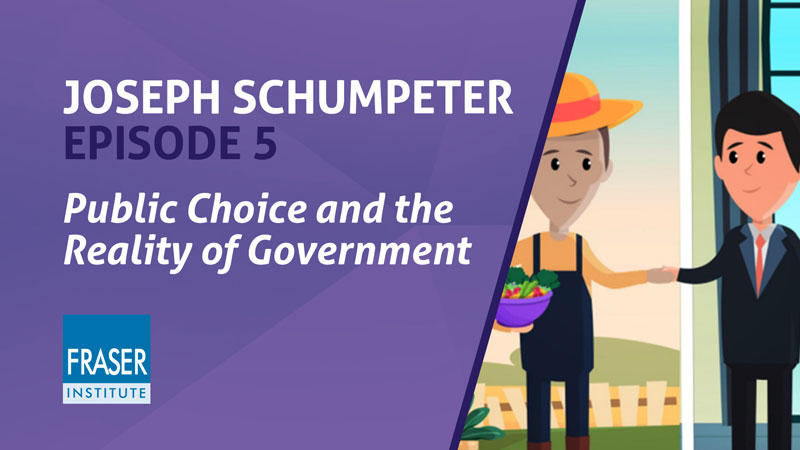
Public Choice and the Reality of Government
Download the Book
Get a digital copy of the book. Choose the version you prefer below.
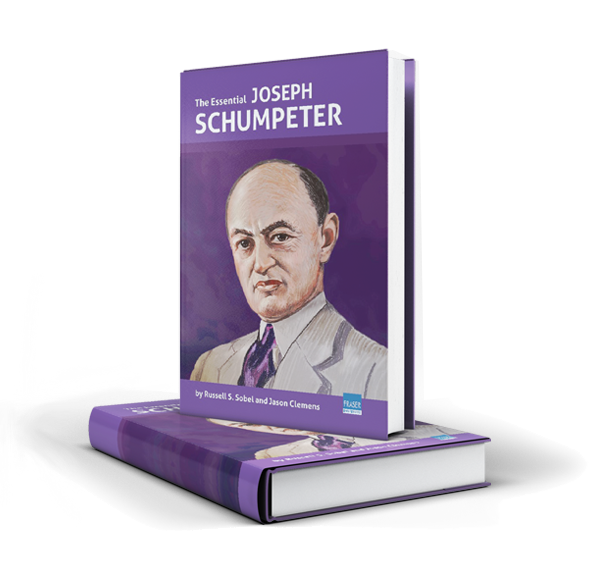




Explore the Book
Chapter by chapter summary of the book.
-
Chapter 1
Who Is Joseph Schumpeter?
Joseph Schumpeter is one of the most accomplished economists of the twentieth century, although he is little known outside academic circles. Included among his many contributions is his path-breaking work on entrepreneurship—one of the quintessential characteristics of all market economies. His timeless phrase describing the entrepreneurial process as one of “creative destruction” is likely second only to Adam Smith’s “invisible hand” in its daily use in popular tweets, blog posts, speeches, and articles. This volume in the Essential Scholars series explores several of Joseph Schumpeter’s most important insights into entrepreneurship, business cycles, economic development, and the democratic process.
-

Chapter 2
Entrepreneurship, New Combinations of Resources, and the Profit-and-Loss System
Would orange slices go well on top of a pizza? How about pineapple? Do they go equally well with ham and turkey as the meat on the pizza? Does turkey even taste good on a pizza? If you have ever been to one of those make-your-own pizza restaurants, you already know there are many possible topping combinations you could, in theory, put on a pizza. With some mathematical formulas, it is possible to figure out exactly how many possible combinations you could make out of a certain set of ingredients; and the numbers get large quickly. If there were twenty different toppings you could use for your pizza, and you were to choose only three of them, how many possible pizza combinations do you think could you make?
-

Chapter 3
Creative Destruction: Schumpeter’s Perennial Gale
If you could get into a time machine (perhaps a DeLorean) and travel back to visit a typical shopping mall in the 1980s, it would have been packed with shoppers. Had you interviewed a store owner about their worries for the future, they would have probably mentioned the fear of facing competition from new stores opening in that mall or from a new mall opening in the same town that might drive them out of business. Indeed, if you visited that same mall today most of the stores in that mall are probably closed and it is depressingly empty, with many vacancies. It turns out, of course, that it was not a new competing mall or other stores in that same mall that the owners should have been worried about driving them out of business … it was the coming of the Internet, and Amazon in particular. But, of course, in the 1980s, there was no such thing as the Internet to worry about, nor did the store owners imagine such a thing would ever exist.
-

Chapter 4
Contestable Markets and the Nature of Competition
In the classic board game, Monopoly, the objective is to drive all of your opponents into bankruptcy by owning and developing blocks of colour-coded property until you are the only remaining player. Players collect rent from their opponents and can charge higher prices as they own more properties of each colour. The game is built on the idea that monopolies—one firm controlling a market—generally produce worse outcomes for consumers (higher prices, for example) than markets characterized by many business firms in competition with one another.
-

Chapter 5
Business Cycles: Understanding the Ebbs and Flows of the Economy
As was the case with many of Schumpeter’s contemporaries, he showed great interest in understanding the nature and causes of business cycles, that is, the ebb and flow of the economy from expansion and prosperity to recession, and at times, economic crisis and depression. Schumpeter’s work in the Theory of Economic Development (TED) coupled with his later two-volume masterpiece Business Cycles (BC1) focused on the broad issue of how and why economies progress. One of the many contributions of Schumpeter’s work in the field of business cycles was the introduction of innovation as a causal explanation. A subtle aspect of his argument, but one that needs to be recognized, is that the business cycle or the fluctuation between expansion and contraction is natural or, as Schumpeter put it “like the beat of the heart”.
-

Chapter 6
Democracy, Public Choice, and Government Policy
Joseph Schumpeter is largely known for his seminal contributions to our understanding of the role of entrepreneurs, innovation, and creative destruction in economic growth and development. However, Schumpeter’s economic insights extend far beyond just his most well-known work on innovation. Another area where Schumpeter was well ahead of the economics profession and provided real insights is the nature of politics and the democratic process of collective decision making. The economic analysis of the process of politics and collective decision making is the focus of a modern field of economics known as public choice. While Schumpeter wrote prior to the formal origins of this field in economics, early scholars such as Anthony Downs did cite and attribute some of his ideas to Schumpeter’s writings in Capitalism, Socialism, and Democracy (CSD).
-
Chapter 7
Can Capitalism Survive?
Perhaps the most interesting aspect of Schumpeter’s lifelong work in economics was a similarity between his work and that of Karl Marx, the most noted socialist writer in history. What makes this similarity striking is that Schumpeter’s greatest insights relate to the role of the innovative entrepreneur at the heart of capitalism. Yet, despite this insight, Schumpeter, like Marx, believed that the economic system of capitalism would eventually be replaced by socialism as a result of forces from within. In Capitalism, Socialism, and Democracy (CSD) Schumpeter himself states: “My final conclusion therefore does not differ, however much my argument may, from that of most socialist writers and in particular from that of all Marxists”.
-
Chapter 8
Entrepreneurial Economist Predicted Socialism
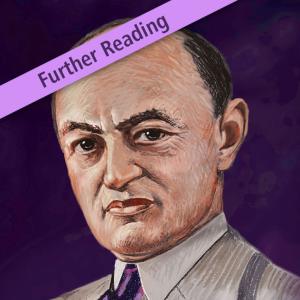
Entrepreneurial Economist Predicted Socialism is a new essay that documents how the early 20th century economist Joseph Schumpeter predicted the end of capitalism as a result of capitalism’s very successes: the declining prominence of the innovator, increased calls for barriers to entry from successful businesses, and calls for government to limit the forces of creative destruction.
About the Author
Russell S. Sobel
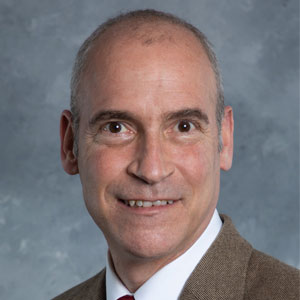
Russell S. Sobel is Professor of Economics & Entrepreneurship in the Baker School of Business at The Citadel in his hometown of Charleston, South Carolina. He received his Ph.D. in economics from Florida State University in 1994. He is co-editor of the Southern Economic Journal and is a member of the editorial boards for the journals Public Choice and the Journal of Entrepreneurship & Public Policy. He serves as a Regional Advisory Committee Member for the South Carolina Revenue and Fiscal Affairs Office Board of Economic Advisors. He is the recipient of numerous awards for both his teaching and research including the Kenneth G. Elzinga Distinguished Teaching Award from the Southern Economic Association, the Georgescu-Roegen Prize for Best Article of the Year in the Southern Economic Journal, the Association of Private Enterprise Education Distinguished Scholar Award, and the Sir Antony Fisher International Memorial Award for his book Unleashing Capitalism. He has produced over two dozen Ph.D. students, most of which have gone on to pursue distinguished academic careers. He is the author or coauthor of over 250 academic journal articles and books including Growth and Variability in State Tax Revenue: An Anatomy of State Fiscal Crises, The Rule of Law, Unleashing Capitalism, and The Essential Joseph Schumpeter. His publications have appeared in a wide variety of academic journals including the Journal of Political Economy, Journal of Law and Economics, Public Choice, Journal of Business Venturing, Small Business Economics, and Economic Inquiry. His research has been featured in many leading news outlets including the New York Times, Wall Street Journal, Washington Post, U.S. News and World Report, Investor’s Business Daily, The Economist Magazine, The Financial Post, CNBC, and the CBS Evening News. His current recent research focuses on the intersection of entrepreneurship and economic policy.

Jason Clemens
Jason Clemens is the Executive Vice President of the Fraser Institute and the President of the Fraser Institute Foundation. He has an Honors Bachelors Degree of Commerce and a Masters Degree in Business Administration from the University of Windsor as well as a Post Baccalaureate Degree in Economics from Simon Fraser University. Before rejoining the Fraser Institute in 2012, he was the director of research and managing editor at the Ottawa-based Macdonald-Laurier Institute and, prior to joining the MLI, Mr. Clemens spent a little over three years in the United States with the San-Francisco-based Pacific Research Institute. He has published over 70 major studies on a wide range of topics, including taxation, government spending, labour market regulation, banking, welfare reform, health care, productivity, and entrepreneurship. He has published over 300 shorter articles, which have appeared in such newspapers as the Wall Street Journal, Investors Business Daily, Washington Post, Globe and Mail, National Post, and a host of US, Canadian, and international newspapers. Mr. Clemens has been a guest on numerous radio and television programs across Canada and the United States. He has appeared before committees of both the House of Commons and the Senate in Canada as an expert witness and briefed state legislators in California. In 2006, he received the coveted Canada’s Top 40 Under 40 award presented by Caldwell Partners as well as an Odyssey Award from the University of Windsor. In 2011, he was awarded (along with his co-authors) the prestigious Sir Antony Fisher International Memorial Award for the best-selling book, The Canadian Century. In 2012, the Governor General of Canada on behalf of Her Majesty the Queen, presented Mr. Clemens with the Queen Elizabeth II Diamond Jubilee Medal in recognition of his contributions to the country.
Additional Resources
No single individual is ever the sole founder of any major stance in political philosophy—or in any other field of human inquiry. For, knowingly or unknowingly, every theorist makes important use of ideas and contentions previously developed by other thinkers. Nevertheless, if one were forced to name the founder of the classical liberal perspective in political thought, one would have to point to the English philosopher John Locke (1632–1704).
When John Locke was born on August 29, 1632, in Wrington, Somerset, England, he entered a world riven by intense religious and political conflict. This conflict reached its greatest intensity in the Civil Wars of 1641–1649 and the rump Parliament’s trial and execution of Charles I in January 1649. It re-emerged in the political and conspiratorial challenges to Charles II from the mid-1670s to mid-1680s and continued through the Glorious Revolution of 1688. Locke studied at the prestigious Westminster School and Christ Church, Oxford. From the late 1660s into the early 1680s he was physician and intellectual aide in the household of the Earl of Shaftesbury, who became the leader of the political forces opposed to the authoritarian tendencies of Charles II.
The Two Treatises of Government were drafted around 1680 in support of Shaftesbury’s attempts to limit monarchical authority. Locke fled to Holland in 1683 after the Rye House plot to assassinate Charles II and his brother James was discovered. A Letter Concerning Toleration was written while Locke was in Holland and probably working to support continued resistance in England to the rule of James II (who had succeeded Charles II in 1685). Both works were published toward the end of 1689 after Locke returned to England following the Glorious Revolution of 1688.
Throughout the 17th century, there was profound conflict across Britain about which religious doctrines and practices were to be mandated by state authority. Most of the parties to disputes concerning religion and the state accepted the premise that the head of state had the right to decree what religion his or her subjects would follow—as long as the sovereign chose the true religion. The only question among these disputants was which religion was the true one that should be imposed by the sovereign. However, further disputes arose between those who accepted the premise that rulers have the right to enforce religious uniformity and advocates of principles of toleration who maintained that rulers must respect the liberty of conscience of their subjects. Britain was also convulsed by a parallel but more general dispute about who possessed ultimate political authority. Was it the monarch? Or was it Parliament? Or was authority somehow divided among different political bodies? Most of the parties to these disputes shared the premise that whoever has political authority has absolute, unlimited political authority.
However, the premise that political authority must be unlimited in its scope came under attack as theorists developed or refined the idea that political authority exists only for certain limited purposes and that when rulers pursue other purposes their actions transgress those limits. Not surprisingly, the contention that the scope of political authority is limited was opposed by defenders of the idea that all sovereigns must have unlimited authority. Locke’s political philosophy fundamentally rejects the doctrine of unlimited, unchecked, political authority as put forward, especially, by Robert Filmer (1588–1653) and Thomas Hobbes (1588–1679). In his Second Treatise of Government and his A Letter Concerning Toleration, Locke synthesizes the arguments for religious toleration and the more general contention that toleration must be extended to all peaceful activities. Locke argued that liberty and not authoritarian control is the basis for a peaceful and prosperous society. As The Essential John Locke explains, the ultimate ground for Locke’s anti-authoritarian advocacy of toleration and liberty is his affirmation of each individual’s possession of natural rights that all other persons—especially political sovereigns—are obligated to respect.
The political conflicts and philosophical disputes that raged in Britain throughout most of the 17th century were, of course, different in their details from the conflicts and disputes of our early 21st-century world. Yet, the fundamental issues are remarkably similar. They include the nature and sanctity of human freedom, the relationship between respect for freedom and the maintenance of social order, the basis and scope of justified toleration, the justifying purpose of government, and the fundamental limits (if any) on governmental authority. Locke’s classical liberal political philosophy speaks to each of these issues (and more).
Classical liberalism is the view that the primary political principle is that individual liberty is to be respected and protected. Individual liberty ranges across both “personal” and “economic” choices. It includes the liberty to decide for oneself what religion one will follow, what aesthetic or cultural values one will prize and pursue, and what personal interactions one will enter into with others (who also choose those interactions). Individual liberty also includes one’s liberty to develop one’s economic capacities as one chooses, to pursue a career of one’s choice, to acquire property as a means of carrying out one’s life plans, and to use one’s acquired property as one chooses—again with the proviso that one’s actions do not deprive others of their like liberties.
Classical liberalism sees each individual as having a moral sovereignty over his or her own life that no individual or group may properly invade or nullify. This does not mean that classical liberalism celebrates a world in which everyone lives in splendid isolation. Rather, it celebrates society as a voluntary association of individuals each of whom is free—singly, but much more likely, in cooperation with others—to pursue his or her own chosen ends in his or her own chosen, albeit liberty respecting, ways. A key component of classical liberalism is the view that individual liberty is at the least the primary source of desirable social and economic order. Desirable social and economic order arises from the ground up. Since ground-up order will reflect the diverse desires, ambitions, knowledge, and capacities of the individuals who make up such an order, such order will necessarily be more complex, vibrant, and dynamic than any order that might be imposed from the top down by social engineers and state planners.
Coercion is the great enemy of liberty and of the benefits of freely chosen cooperative endeavours. From the classical liberal perspective, the only acceptable coercion is coercion that is provoked by and directed against unprovoked coercion. Coercion—especially understood as the use of physical force or the threat of such use—may be employed only in defence of the liberty of individuals and the associations they voluntarily form. The distinctive feature of political institutions, that is, of governments, is their possession and use of coercive power. Hence, the classical liberal’s endorsement of respect for and protection of individual liberty as the primary political principle yields a demand for radical limits on state power and action.
Locke never married and during his later years lived with the family of Lady Damaris Cudworth Masham at Oates in High Laver, Essex. He died on October 28, 1704 and was buried in the churchyard of the village of High Laver.
Watch the Videos
Who was John Locke?
Natural Freedom and Rights
The Right to Property
The Purpose of Government
Religious Tolerance
Download the Book
Get a digital copy of the book. Choose the version you prefer below.
Explore the Book
Chapter by chapter summary of the book.
-

Chapter 1
The State of Nature and the Law of Nature
In his Second Treatise of Government, Locke follows Hobbes in approaching political philosophy through state-of-nature theory. According to both Hobbes and Locke, a group of individuals are in a state of nature (relative to one another) if they are not subject to a common governmental authority. Being in a state of nature is our original, baseline condition because no one is born subject to political authority. Our birth—or, to put matters more precisely, our entrance into adulthood—does not brand us with an obligation to obey those who aspire to rule over us. Nor does their birth—or their entrance into adulthood—bestow on them the right to rule us. Although we are not literally born as “free and independent” beings, we are born to freedom and independence in the sense that we each attain this status when we reach adulthood.
In our original natural condition, we are equally and perfectly free. There is no natural hierarchy of ruler and subjects. This view was dramatically expressed by Richard Rumbold before his execution on June 26, 1685 for his participation in the Rye House plot: “No man is born marked by God above another, for none comes into the world with a saddle on his back, neither any booted and spurred to ride him”. Since there is no natural political authority, it seems that, if some party has a right to rule while others have correlative obligations to obey, that right and those obligations must have been created by the individuals in the course of exiting from the state of nature. State-of-nature theory investigates whether people have good reason to exit the state of nature by creating and placing themselves under the sway of governmental power.
-
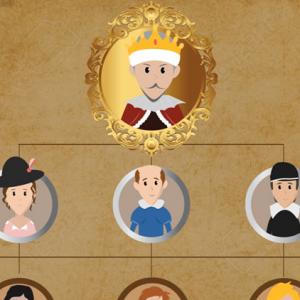
Chapter 2
Natural Freedom
The main goal of this chapter is to spell out Locke’s understanding of freedom and highlight how it differs from the view that freedom is a matter of doing whatever one wants to do. Locke, as a classical liberal, holds that everyone has a right to freedom—but not a right to do whatever one wants to do.
Hobbes and Locke seem to agree that all individuals (who have reached the age of reason) are naturally equal and free. However, for Hobbes, this natural equal freedom is a matter of no one being naturally subject to any other person or to any constraining principles of law or justice. For Hobbes, to be free is to be able to do whatever one desires to do. Any constraint on how one may act constitutes a denial of freedom. In contrast, Locke holds that our natural equality and freedom is a matter of each of us having a natural right against being subordinated to the will of others. Our freedom consists in others not subordinating us to their will. The freedom of others is not compromised when they are required not to subordinate us to their will—even if they desire to engage in such subordination. The freedom of others is compromised only if they are subordinated to our will. A corollary of each person’s right to freedom is each other person’s obligation not to infringe upon that freedom.
-
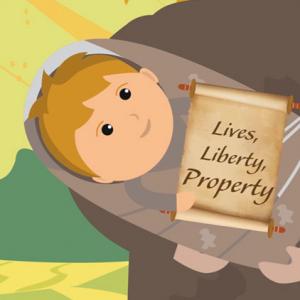
Chapter 3
Natural Rights
In this chapter, I present Locke’s arguments for each person possessing a natural right to freedom. Locke’s view is that each person’s right to freedom takes the form of each person’s rights over his or her own person and his or her possessions. The right to freedom and the right not to be deprived of discretionary control over one’s person and possessions are two sides of the same coin. In addition, Locke equates infringements on one’s freedom with being subordinated to the will of others. Thus, Locke’s arguments for respect for individual freedom sometime focus on the reasons we each have to demand freedom for ourselves and to acknowledge others’ like demand for freedom; sometime focus on the claim that each of us has against being harmed “in his life, health, liberty, or possessions”; and sometime focus on the reasons that it is unjustified for any individual to be subordinated to the will of another.
-

Chapter 4
Property Rights
Locke tells us that the right to freedom includes the right to do as one sees fit with one’s possessions. Yet he cannot mean the right to do as one sees fit with whatever one actually possesses for he does not think that one has rights to do as one sees fit with objects one has acquired illicitly, that is, through theft or fraud. Such a right would conflict with the rights of the victims of theft and fraud to do as they see fit with their possessions. So, Locke needs a theory of property rights that explains why certain methods of acquisition engender rights to the acquired objects and why other methods of acquisition do not engender such property rights.
In his First Treatise, Locke argues that, since “Man should live and abide for some time upon the face of the Earth”, he must have a right “to make use of those things, that were necessary or useful to his Being”. If human beings are to have a chance of achieving commodious preservation, they must have the opportunity to use and, indeed, exercise discretionary control over objects that are external to their own persons, for instance, acorns, plows, and fields cleared for cultivation.
-

Chapter 5
Inconveniences of the State of Nature and Their Remedy
Recall that, besides rights to life, liberty, and estate, each individual possesses by nature rights to engage in self-defence, to extract restitution for rights-violating losses, and to punish rights violators. If Abe attempts to enslave Bea on the isolated island that they inhabit, Bea may use force (or deception) to thwart Abe. If Abe manages to enslave her, Bea has the right not only to escape but also to extract reparations from Abe and to punish Abe for his violation of her right to liberty. Locke refers to these rights to protect and enforce the rights of life, liberty, and estate as “the executive power of the law of nature”.
Locke holds that in the state of nature—especially prior to the introduction of money—most people will be inclined to comply with others’ rights to life, liberty, and estate, at least when they expect reciprocal compliance by others. However, this is not true of all people. People who do not consult reason, which teaches us that we are each equal and independent beings who are not to be subordinated to others, may well not abide by core laws of nature. Others may consult reason and, thus, be aware that each person is “absolute lord of his own person and possessions” and yet still tend to behave “as beasts of prey”. Some people may desire “the benefit of another’s pain” and, hence, attempt to seize the labour of others or the products of their labour or the goods these others have acquired through voluntary exchange.
-

Chapter 6
The Obligation to Obey Legislation and Its Radical Limits
In this chapter, I address Locke’s view about why individuals are obligated to abide by the legislation that is enacted by government as long as those enactments accord with the purpose that Locke sets forth for governments, viz., to better articulate and enforce their rights of life, liberty, and property.
One of the four or five major themes most commonly associated with Locke’s political doctrine is the claim that each individual’s obligation to obey the legislation of the government under which he lives rests on that individual’s consent. A government’s authority to impose its statutes on its subjects must derive from the consent of the governed. Locke tells us that “[m]en being … by nature, all free, equal, and independent, no one can be put out of this estate, and subject to the political power of another, without his own consent”. Similarly, since every person is naturally free, nothing can “put him into subjection to any earthly power but only his own consent”. Locke is especially eager to maintain that sons cannot be bound by the consent of their fathers: “a child is born a subject of no country or government … there is no tie upon him by his father’s being a subject of this kingdom; nor is he bound up by any compact of his ancestors”.
-

Chapter 7
Toleration
Locke’s A Letter Concerning Toleration (1689) is his second best-known work in political philosophy and is one of the great essays on behalf of religious toleration. Locke defends toleration for all Protestant sects and, much more radically, for Jews and Muslims. However, Locke did not advocate full toleration for Catholics and atheists. This was not because of Catholic or atheist doctrine as such but, rather, because Catholics and atheists were politically suspect. According to Locke, Catholics were suspect because of their political loyalty to the Pope and often to the tyrannical Catholic monarchies in Spain or France. Atheists were politically suspect because they could not take themselves to be bound by their oaths to God.
-

Chapter 8
Resistance against Unjust Force
This final chapter will describe Locke’s bold doctrine of justified forceful resistance against state agents—monarchs, legislators, or their henchmen—that encroach upon the rights of individuals and of political society. Recall that Two Treatises of Government was largely composed in the early 1680s. When it was published in 1689, it was seen—and served—as a justification after the fact for the Glorious Revolution of 1688, which deposed James II, the successor to Charles II. However, it was initially composed in support of attempts by Locke’s patron, Lord Shaftesbury, to check the power of Charles II.
As was mentioned in the Introduction, a deep premise of Locke’s doctrine of justified resistance is that state agents, including heads of state, are subject to the same fundamental moral constraints as ordinary persons. If a certain type of action by a private individual violates the rights of another individual, an action of the same type performed by a state agent will also violate that individual’s rights. If it is a violation of Abe’s rights for Bea to lock him up in her backyard shed for entering into economic competition with her or her friends, it is also a violation of Abe’s rights for the monarch or the legislators to lock Abe up in the Tower of London for entering into economic competition with the monarch or the legislators or their cronies. If it is criminal for Bea to burn Abe at the stake in her backyard for rejecting the doctrines of Bea’s church, it is equally criminal for the monarch to burn Abe at the stake in the town square for rejecting the doctrines of the monarch’s church.
About the Author
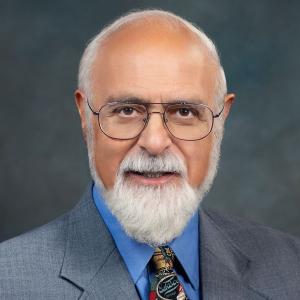
Eric Mack
Eric Mack is Emeritus Professor of Philosophy at Tulane University. As a member of the Department of Philosophy and a faculty member of the Murphy Institute of Political Economy at Tulane, he taught courses in ethical theory, the philosophy of law, political economy, political philosophy, and the history of political theory. His primary scholarly project has been the refinement and extension of the sort of natural-rights doctrine that John Locke advocated in his political writings.
To that end, he has published about 100 scholarly essays on the moral foundations of natural rights, the basis and nature of property rights, economic justice, the nature of law and of spontaneous economic and social order, the scope of legitimate coercive institutions, and the exploration of these topics by 17th and 19th century classical liberal and libertarian theorists. He is the editor of Auberon Herbert’s The Rights and Wrongs of Compulsion by the State and Other Essays (Liberty Press) and Herbert Spencer’s The Man versus the State (Liberty Press). He is also the author of John Locke (Bloomsbury Press) and, most recently, Libertarianism (Polity Press).
He exercises his freedom and rugged self-reliance by hiking and backpacking in the mountains and canyon country of the American West.
Additional Resources
When economists are called “influential,” it usually means they’ve changed the way other economists think. By that standard, Milton Friedman was one of the most influential economists of all time. He revolutionized the way economists think about consumption, about money, about stabilization policy, and about unemployment.
He demonstrated the power of committing oneself to a few simple assumptions about human behaviour and then relentlessly pursuing their logical implications. He developed and taught new ways of interpreting data, testing his theories by their ability to explain multiple disparate phenomena. His successes were spectacular and his techniques were widely emulated.
In several cases, Friedman’s methods inspired the creation of entire new subfields including the economic analysis of law, the quantitative approach to economic history, the economics of crime and punishment, the economics of family relationships, and the economic approach to finance—leading to multiple Nobel prizes for Friedman’s acolytes.
But Friedman’s influence extended beyond economists. To the public at large, he was the world’s foremost advocate for economic and personal freedom. Through his writings and his media appearances, he educated millions about how markets work and how governments often fail. He restored the respectability of classical liberal notions that had fallen into disfavour, and he did so not by artful propaganda but by conveying a deep and lasting understanding of the ideas themselves.
And he influenced policymakers. In the United States, he helped to end the military draft, to broaden educational choice, and to change the regulatory climate. Worldwide, almost all central banks now follow policies that are grounded in Friedman’s insights and recommendations (updated, of course, for the changed world we now live in), and have thereby made the world a richer and more stable place, largely delivered from the sort of disastrous policy errors that were once routine. When the Soviet Union collapsed, Friedman’s writings inspired the design of new institutions in several former Communist countries, and those that adopted this course were rewarded with prosperity and freedom.
After an early flirtation with statistics (where he developed the “Friedman Test” to interpret disagreements among judges in, say, a skating competition), Friedman moved on to study economics, writing a 1946 doctoral dissertation on, among other things, the effects of occupational licensing, a subject to which he frequently returned. The next year, he accepted a job at the University of Chicago, where he did most of his groundbreaking academic work on consumption behaviour, monetary theory, and monetary history, and served as the undisputed intellectual leader of the economics department for 30 years. In 1976, he was awarded the Nobel Prize.
The public became acquainted with Friedman through his 1962 bestseller Capitalism and Freedom and his subsequent series of approximately 300 columns in Newsweek Magazine, along with his increasing presence as an advisor to policymakers. After his retirement in 1977, Friedman moved to the Hoover Institution at Stanford University and, in collaboration with his wife Rose and the television producer Robert Chitester, created the television series Free to Choose and an accompanying book by the same title. Both the TV series and the book drew huge audiences and cemented Friedman’s worldwide celebrity. Several Eastern European leaders specifically cited Free to Choose as a major inspiration for their new economic policies after the fall of the Soviet Union.
It would take several large volumes to do justice to Friedman’s extraordinary contributions to economic theory, economic practice, economic policy, and economic literacy. The few brief chapters that follow will give an overview of what those volumes might contain.
Listen In
Milton Friedman Part 1: Monopolies and Rising Prices
Steven E. Landsburg, Professor of Economics at the University of Rochester and author of The Essential Milton Friedman, joins host Rosemarie Fike to discuss Friedman’s profound contributions to the field of economics throughout the 20th century, including his work on monopolies and the impact of rising prices.
- Follow or Subscribe:
Milton Friedman Part 2: Government Control and Long-Term Consequences
Steven E. Landsburg, Professor of Economics at the University of Rochester and author of The Essential Milton Friedman, returns to discuss Friedman’s most salient ideas with host Rosemarie Fike, specifically how the expansion of government power may enable positive change but can just as easily enable negative societal change, ultimately removing choice from people and consumers.
- Follow or Subscribe:
Watch the Videos
Who was Milton Friedman
The Permanent Income Hypothesis
The Permanent Income Hypothesis and Policy Implications
Expected vs. Unexpected
The Theory of Money and Prices
Download the Book
Get a digital copy of the book. Choose the version you prefer below.
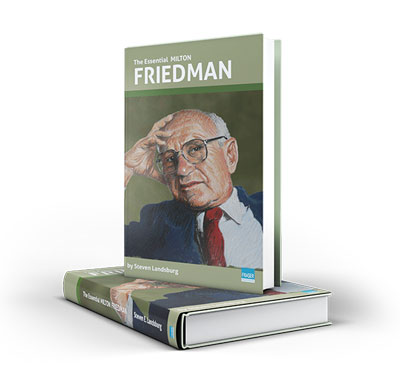
Explore the Book
Chapter by chapter summary of the book.
-

Chapter 1
The Permanent Income Hypothesis
Suppose you believe your economy is in the doldrums because people are somehow not spending enough. How do you get them to open up their pocketbooks?
Start by perusing some data. You’ll quickly discover that spending is highly correlated with income. It’s well documented that if, in any given year, Alice out-earns Bob by a dollar, then on average she’ll outspend him by at least 90 cents.
-
Chapter 2
Money, Prices, and Inflation
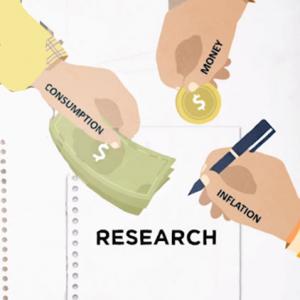
The Nobel Prize-winning economist Robert Solow once observed that “Everything reminds Milton of the money supply.” It’s certainly true that Milton Friedman had a lifelong fascination with the money supply, leading to insights that profoundly changed both academic thought and practical policymaking.
Actually, Friedman’s analysis begins on the other side of the market—the demand for money—as opposed to the supply. To the casual reader, the idea of studying the “demand for money” might sound absurd. Don’t we all want as much money as we can possibly get? Isn’t that all there is to say on the matter?
-

Chapter 3
Monetary Policy
Now that we’ve talked about how the price level is determined, let’s double back and ask why we should care about the price level in the first place. If the money supply doubles, and all prices (including wages) double in response, has anything important really changed?
Probably not. Instead of costing $5, a hamburger now costs $10. Alice has to work just as many hours to earn that $10 hamburger today as she worked to earn a $5 hamburger yesterday. Instead of carrying $25 in her pocket (enough to buy five hamburgers), she’ll carry $50—still enough to buy five hamburgers. Instead of keeping $1,000 in her chequing account, she’ll keep $2,000—the same fraction of her income that she’s always kept.
-

Chapter 4
Monetary History
The quantity theory of money—that is, the circle of ideas surrounding the notion that prices tend to move in tandem with the money supply—has a long history going back to the astronomer Nicolaus Copernicus in the fifteenth century. After the onset of the Great Depression in the early 1930s, the new generation of “Keynesian” economists largely rejected the quantity theory, arguing that often, people don’t have strong stable preferences about how much money they hold. Therefore, said the Keynesians, when the authorities inject new money into the system, people might simply hold it, without bidding up prices.
-

Chapter 5
Unemployment
In 1958, the economist William Phillips noticed a striking correlation: Times of high inflation are times of low unemployment, and vice versa. Over the next decade, the correlation held strong.
The lesson most economists drew was that policymakers face a trade-off: You can have less unemployment, provided you’re willing to tolerate (and even engineer) a bit more inflation.
Milton Friedman, almost a lone voice in the wilderness, begged to differ. Not for the first time in his career, it fell to Friedman to remind the world that correlation is not the same as causation.
-

Chapter 6
Chicago Price Theory
From his arrival at the University of Chicago in 1946 until his retirement in 1977, Milton Friedman did more than anyone to set the intellectual agenda of the Chicago economics department. Though Friedman was primarily known as a monetary economist, the subject he chose to teach was price theory, or microeconomics. Microeconomics was a required first-year graduate-level course and it shaped the thinking of generations of students, giving them an extraordinarily rich set of tools for analyzing problems in all areas of economics.
-
Chapter 7
Capitalism and Freedom
In 1962, Milton Friedman burst forth from the academy into the public square with Capitalism and Freedom, subsequently ranked number 16 on Time Magazine’s list of the most influential books written in English in the years 1923–2011.25 More than half a century later, it remains in print in over a dozen languages and ranks near the very top of Amazon’s list of bestsellers in economic theory.
-

Chapter 8
Policy Analysis
Having drawn the connection between free markets and free people, Friedman moved on to specifics. The later chapters of Capitalism and Freedom make the case for limiting the role of government in education, labour markets, corporate governance, housing, old age insurance, the alleviation of poverty, and more.
-

Chapter 9
Activism
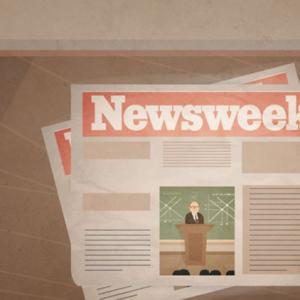
After the success of Capitalism and Freedom, Milton Friedman became the world’s most widely recognized advocate for economic freedom. His op-ed columns in Newsweek, appearing every three weeks for 18 years, reached a direct audience of about three million subscribers and were widely quoted in other media. Soon his face and his voice were familiar to many millions more, through his frequent congressional testimony, public speeches, and media appearances.
-
Chapter 10
Civil Discourse
In 1980, Milton and Rose Friedman collaborated with the visionary television producer Bob Chitester to create a television series called Free to Choose. The series aired originally on the Public Broadcasting System in the United States, where, with about three million viewers per episode, it was one of the most popular programs in PBS history. A companion volume with the same title, written by the Friedmans, was near the top of the year’s bestseller lists.
About the Author

Steven E. Landsburg
Steven E. Landsburg is a professor of economics at the University of Rochester. He is the author of Can You Outsmart an Economist?, The Big Questions, More Sex is Safer Sex, Fair Play, The Armchair Economist, two textbooks on economics, and over 30 journal articles in mathematics, economics and philosophy. He has written regularly for Forbes and Slate and occasionally for The Wall Street Journal, The New York Times, and other publications.
Additional Resources
Adam Smith was born in 1723 in Kirkcaldy, Scotland. Smith was one of the principals of a period of astonishing learning that has become known as the Scottish Enlightenment, which included groundbreaking innovations in everything from medicine to geology to chemistry to philosophy to economics. Smith is the author of two published books: The Theory of Moral Sentiments (TMS), in 1759, and An Inquiry into the Nature and Causes of the Wealth of Nations (WN), in 1776. TMS brought Smith considerable acclaim during his lifetime and was soon considered one of the great works of moral theory—impressing, for example, Charles Darwin (1809–82), who in his 1871 Descent of Man endorsed and accepted several of Smith’s “striking” conclusions. And TMS went through fully six revised editions during Smith’s lifetime. Yet since the nineteenth century, Smith’s fame has largely rested on his second book, which, whether judged by its influence or its greatness, must be considered one of the most important works of the second millennium.
Not many details of Smith’s boyhood are known. He was born on the 5th of June and was an only child. His father, also named Adam Smith, died shortly before he was born. In his 1793 Account of the Life and Writings of Adam Smith, LL.D., Smith’s student Dugald Stewart reports that Smith’s “constitution during infancy was infirm and sickly, and required all the tender solicitude of his surviving parent. She was blamed for treating him with an unlimited indulgence; but it produced no unfavourable effects on his temper or his dispositions” (Smith, 1982a: 269). Perhaps one anecdote from Smith’s childhood bears repeating. Margaret, Smith’s mother, would regularly take him to Strathenry, about seven miles northwest of Kirkaldy, to visit her brother, Smith’s uncle. On one visit, when the wee Smith was but three years old, he was playing in front of his uncle’s house and was kidnapped by a passing group of “gypsies.” The alarm was raised and the kidnappers were discovered and overtaken in the nearby Leslie wood, whereupon the wailing toddler was safely returned to his family. Stewart writes that Smith’s uncle, who recovered Smith, “was the happy instrument of preserving to the world a genius, which was destined, not only to extend the boundaries of science, but to enlighten and reform the commercial policy of Europe” (Smith, 1982: 270).
Smith matriculated at the University of Glasgow in 1737 at the age of fourteen and in 1740 was elected as a Snell exhibitioner at Balliol College, Oxford. Smith was apparently not impressed with the quality of instruction at Oxford, however. As he wrote years later in WN, “In the university of Oxford, the greater part of the public professors have, for these many years, given up altogether even the pretence of teaching” (WN: 761). Smith was able to make good use of the libraries at Oxford, however, studying widely in English, French, Greek, and Latin literature. He left Oxford and returned to Kirkcaldy in 1746.
In 1748, at the invitation of Henry Home Lord Kames (1696–1782), Smith began giving in Edinburgh “Lectures on Rhetoric and the Belles Lettres,” focusing on literary criticism and the arts of speaking and writing well. It was during this time that Smith met and befriended the great Scottish philosopher David Hume (1711–76), who was to become Smith’s closest confidant and greatest philosophical influence. Smith left Edinburgh to become Professor of Logic at the University of Glasgow in 1751, and then Professor of Moral Philosophy in 1752. The lectures he gave at Glasgow eventually crystallized into The Theory of Moral Sentiments, which was published to great acclaim in 1759.
In 1763 Smith resigned his post at Glasgow to become the personal tutor of Henry Scott, the Third Duke of Buccleuch, whom Smith then accompanied on an eighteen-month tour of France and Switzerland. During these travels with the young Duke, Smith met Voltaire (1694–1778), on whom Smith apparently made quite an impression: Voltaire later wrote, “This Smith is an excellent man! We have nothing to compare with him, and I am embarrassed for my dear compatriots” (Muller, 1993: 15). Smith also met François Quesnay (1694–1774), Jacques Turgot (1727–81), and others among the so-called French Physiocrats, who were arguing for a relaxation of trade barriers and generally laissez-faire economic policies. Although Smith had already been developing his own similar ideas, conversations with the Physiocrats no doubt helped him refine and sharpen them. In 1767, Smith returned to Kirkcaldy to care for his ailing mother and to continue work on what would become his Wealth of Nations. During this time he was supported by a generous pension from the Duke of Buccleuch, enabling him to focus on his scholarly work. It was widely known that the celebrated author of TMS was working furiously on a new book, and the ten years he labored on it raised expectations high indeed. Finally, at long last, Smith’s magnum opus was published on March 9, 1776.
Smith remained in Kirkcaldy until 1778, when he became Commissioner of Customs in Edinburgh. During the decade or so that he spent in Kirkcaldy, and then thereafter when he was in Edinburgh, Smith spent a great deal of time visiting with and entertaining friends, among whom he counted Irish Catholic philosopher and statesman Edmund Burke (1729–97), the chemist Joseph Black (1728–99), the geologist James Hutton (1726–97), the mechanical engineer James Watt (1736–1819), Prime Minister Frederick (Lord) North (1732–92), and Prime Minister William Pitt the Younger (1759–1806). He also took active roles in learned organizations like the Oyster Club, the Poker Club, and the Select Society, the last of which included among its members William Robertson (1721–1793), David Hume, James Burnett Lord Monboddo (1714–99), Adam Ferguson (1723–1816), and Lord Kames. In 1783, Smith was a founding member of the Royal Society of Edinburgh, which exists still today as Scotland’s premier national academy of science and letters. Having previously served as the University of Glasgow’s Dean of Arts (1760) and Vice-Rector (1761–63), in 1787 he was elected Lord Rector of the university, a post he held until 1789.
During his years in Edinburgh, Smith extensively revised both TMS and WN for new editions. In 1785, he wrote to Le Duc de La Rochefoucauld that “I [Smith] have likewise two other great works upon the anvil; the one is a sort of Philosophical History of all the different branches of Literature, of Philosophy, Poetry and Eloquence; the other is a sort of theory and History of Law and Government” (Smith, 1987: 248). Neither of these projects was ever published, however. In the days before he died, Smith summoned his friends Black and Hutton to his quarters and asked that they burn his unpublished manuscripts, a request they had resisted on previous occasions. This time Smith insisted. They reluctantly complied, destroying sixteen volumes of manuscripts. It is probable that Smith’s philosophical history of literature, philosophy, poetry, and eloquence, and his theory and history of law and government were among the works that perished in that tragic loss.
Adam Smith died in Edinburgh on 17 July 1790 and is buried in the Canongate cemetery off High Street in Edinburgh.
Listen In
Adam Smith—Through Sympathy There is Progress
James R. Otteson, Professor of Business Ethics at the University of Notre Dame and co-author of The Essential Adam Smith, joins host Rosemarie Fike to discuss Smith’s concept of sympathy, and how paying attention to the feedback our behaviours elicit from others is what enables progress and change within society.
- Follow or Subscribe:
Adam Smith part 2: Why Care? It’s Only Natural
James R. Otteson, Professor of Business Ethics at the University of Notre Dame and co-author of the Essential Adam Smith, joins host Rosemarie Fike to discuss Smith’s perennial insights, including how human engagement naturally presents itself as opportunities for cooperation, and the ways in which the free-market can be a vehicle for this.
- Follow or Subscribe:
Watch the Videos
The Invisible Hand
The Role of Government
Cronyism
Moral Sentiments

Labour Markets
Who is Adam Smith?
Download the Book
Get a digital copy of the book. Choose the version you prefer below.
Explore the Book
Chapter by chapter summary of the book.
-

Chapter 1
What is Political Economy?
The discipline we know today as “economics” began as “political economy” in the eighteenth century. The early political economists, including Adam Smith and David Hume, wanted to adapt a Newtonian scientific methodology to the study of human behavior and human society, for two principal and connected purposes: first, to discover, from history and empirical observation, regular patterns of behavior that could be systematized and therefore explained and understood; and second, to use those discovered patterns as empirical bases from which to make recommendations about institutional reform. They reasoned that if we could understand how human social institutions work, then perhaps we can understand what the moral, political, economic, and cultural institutions are that conduce to human prosperity—and, of course, which do not.
-
Chapter 2
Sympathy, moral sentiments, and the impartial spectator
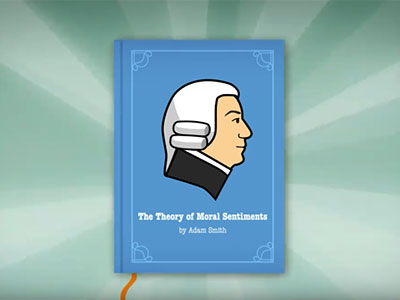
Adam Smith’s first book was The Theory of Moral Sentiments (TMS), first published in 1759. It went through six editions in his lifetime, all of them revised by him, with the sixth and final edition coming out shortly before he died in 1790. TMS is based on lectures Smith had been giving regularly at the University of Glasgow beginning in 1752. TMS quickly established Smith as a leading moral philosopher, both in Britain and on the European continent, and for the rest of Smith’s life—and for some time afterwards—it was one of the single most influential books of moral philosophy. The great philosopher Immanuel Kant (1724–1804), for example, was deeply influenced by Smith’s TMS. He went so far as to call Smith his “Liebling,” or “favorite.” Why did TMS have such a pronounced effect?
-

Chapter 3
The solitary islander and moral objectivity
We saw in the previous chapter that Smith believes our moral sentiments develop over time by an almost evolutionary process that depends on interactions with others. There are two other important elements of Smith’s argument that will fill out his account of the origins of human morality.
-
Chapter 4
Justice and beneficence
In his 1759 Theory of Moral Sentiments, Adam Smith divides moral virtue into two broad categories: “justice” and “beneficence.” Smith describes “justice” as a “negative” virtue, meaning that to fulfill it we must merely refrain from injuring others. By contrast, “beneficence” is a “positive” virtue, meaning that to fulfill it we must engage in positive action to improve others’ situations. Beneficence includes for Smith things like charity, generosity, and friendship, things that inspire gratitude in the beneficiaries of our actions. Justice, on the other hand, requires that we do not harm or injure others; if we breach justice, then we inspire resentment in those we hurt.
-

Chapter 5
The marketplace of morality
As we saw in Chapter 1, Adam Smith was first and foremost a moral philosopher. In his Theory of Moral Sentiments, he wanted to understand how human beings come to have the moral sentiments they do, and how they form the moral judgments they do. We saw in the previous three chapters that Smith described a process by which individuals develop moral sentiments over time, through interaction with others, and based on the experiences they have watching others judge and perceiving being judged themselves. In the Introduction, I raised the historical and scholarly issue known as the “Adam Smith Problem,” which alleges a rift between the account of morality Smith gives in TMS, on the one hand, and the seemingly different account of political economy Smith gives in his Wealth of Nations, on the other. Can the two accounts be reconciled? I argued in Chapter 1 that both accounts could be reconciled by a proper understanding of Smith’s “political economy” project. In this chapter, let me lay out how the projects of Smith’s two books go together.
-
Chapter 6
The division of labor
Adam Smith’s An Inquiry into the Nature and Causes of the Wealth of Nations was published on March 9, 1776. It had been in the works for over a decade, and Smith—who was by now the celebrated author of the highly acclaimed 1759 Theory of Moral Sentiments—found himself the object of a great deal of anticipation. Th e leading thinkers of the day knew Smith had been working on a magnum opus, and they had heard hints and suggestions about what might be in it. But he had been working on it so long that the anticipation had grown to worrying heights, since those who had been so impressed by TMS began to worry that its author could not equal his accomplishment in his first book.
-
Chapter 7
Smithian political economy
We saw in the previous chapter that Smith believed the key to increasing prosperity was the division of labor. He argued that specialization would lead to increasing production, which leads to decreasing prices, which in turn leads to increasing standards of living. We also saw that he thought this story of prosperity could ensue only in a “well-governed society,” which for him is one that, whatever else is the case, has “an exact administration of justice.” In Chapter 10, we will look more specifically at the role Smith believes the government should play in society. But can we say a bit more about how Smith thinks prosperity is generated? What, for him, are the causes of the wealth of nations?
-
Chapter 8
The invisible hand
As we saw in the previous chapter, Adam Smith’s political economy is based on a chain of three arguments. The first we called the Economizer Argument, or the claim that each person naturally seeks out the most economical use of the resources available to him to achieve his goals, whatever they are. Whatever one’s goals, one wants to achieve them as efficiently as possible. Smith’s claim is that no one needs to tell us to do this: we are psychologically constructed, as it were, to do so already. The second argument is the Local Knowledge Argument, which has a couple of steps. First is the claim that people tend to know their own goals and purposes, as well as opportunities and available resources, better than others. Next is the claim that in order to use resources wisely, decisions about how to use them must be based on this knowledge of people’s goals, purposes, opportunities, and resources
-

Chapter 9
Self-interest, equality, and respect
In the last two chapters we saw that, according to Adam Smith, in a “well-governed society” (which for him meant one that protects his “sacred” “3 Ps” of person, property, and promise) each of us would naturally seek out ways to achieve our own ends by becoming “mutually the servants of one another” and thereby would benefit others even as we seek to benefit ourselves. According to Smith, the task of the political economist is to conduct empirical, historical investigations to discover what the policies and institutions are that would enable “universal opulence” and “general plenty.”
-
Chapter 10
The role of government
One might be surprised to learn that Adam Smith did not advocate or rely on a theory of natural law or natural rights. He had read his John Locke (1632–1704), of course, and the surviving students’ notes from the lectures on jurisprudence he gave at the University of Glasgow—Smith’s own lecture notes do not survive—record that Smith extensively discussed Locke’s theory of natural law and natural rights. But when it came to Smith’s own discussion of and justification for the proper role of government in human life, natural law and natural rights play no role. Similarly, Smith gave us no overt theory of property, let alone private property. So unlike Locke—and the American founding fathers, many of whom read Smith—Smith does not argue that the government’s job is to protect our natural rights to “life, liberty, and estate” (Locke) or to protect our “unalienable rights” to “life, liberty, and the pursuit of happiness” (Jefferson in the Declaration of Independence).
-

Chapter 11
Government interventions in the economy?
We saw in the previous chapter that Smith argues for a negative, defense only (or NDO) conception of justice, which seems to entail that the government’s primary, perhaps only, job is to protect us against invasion of what he articulates in TMS as our “3 Ps”: our persons, our property, or our voluntary promises (TMS: 84). That is consistent with the first two duties of government he articulates in WN, namely, protection from foreign invasion and protection from domestic invasion. But note what Smith argues is the third and final duty of government: “the duty of erecting and maintaining certain publick works and certain publick institutions, which it can never be for the interest of any individual, or small number of individuals, to erect and maintain; because the profit could never repay the expence to any individual or small number of individuals, though it may frequently do much more than repay it to a great society” (WN: 687–8). Has Smith here opened the door to a more interventionist government than his NDO conception of justice seemed to entail?
-
Chapter 12
Final assessment
We have now come to the conclusion of the main elements of Adam Smith’s thought. We have covered everything from who he was, to what his conception of the nature and purpose political economy is, to his moral theory, to the role he thinks the desire for mutual sympathy of sentiments plays in the development of our moral standards, to the connection between his Theory of Moral Sentiments and Wealth of Nations, to his explanation of what wealth is and what its causes are, to his conception of and distinction between justice and beneficence, and to the role he believes government should play in our lives. What remains? We have yet to off er a final assessment of Smith’s work and importance.
About the Author

James R. Otteson
James R. Otteson, Senior Fellow at the Fraser Institute, is John T. Ryan Jr. Professor of Business Ethics and Faculty Director of the Business Honors Program in the Mendoza College of Business at the University of Notre Dame, and a Senior Scholar at The Fund for American Studies. He received his BA from the Program of Liberal Studies at the University of Notre Dame and his PhD in philosophy from the University of Chicago. He specializes in business ethics, political economy, the history of economic thought, and eighteenth-century moral philosophy. He has taught previously at Wake Forest University, New York University, Yeshiva University, Georgetown University, and the University of Alabama. Prof. Otteson’s books include Adam Smith’s Marketplace of Life (Cambridge, 2002), Actual Ethics (Cambridge, 2006), Adam Smith (Bloomsbury, 2013), The End of Socialism (Cambridge, 2014), Honorable Business: A Framework for Business in a Just and Humane Society (Oxford, 2019), and The Essential David Hume (Fraser Institute, 2021). His latest books include Seven Deadly Economic Sins (Cambridge, 2021); and Should Wealth Be Redistributed? A Debate (with Steven McMullen; Routledge, 2022).
Additional Resources
Born in Vienna on May 8, 1899, Friedrich A. Hayek moved to England in 1931. While teaching and researching at the London School of Economics, Hayek became one of the world’s most renowned economists even though he was still only in his mid-30s. His fame grew from his research into the causes of what were then called “trade cycles,” what we today call booms and recessions.
In the greatly depressed 1930s, of course, such research was especially important. And Hayek wasn’t alone in researching the causes of booms and recessions. Another economist studying the same matter was John Maynard Keynes (pronounced “canes”). Yet Keynes’s theory of booms and recessions was totally different from Hayek’s. Not only were the two accounts of booms and recessions very different from each other at the purely theoretical level, they also differed in the implications they offered for government policies to deal with economic slumps. Keynes’s theory promised that recessions, even deep ones like the Great Depression, can easily be cured by greater government spending. Hayek’s theory, on the other hand, offered no hope that a slumping economy can be cured by any such easy fix.
Among professional economists, Hayek’s theory went quickly from being celebrated to being scorned. Keynes’s theory won the day.
Whatever the reasons for Keynes’s victory over Hayek, that victory was total. Keynesian economics came to all but completely dominate the economics profession for the next 40 years and to win widespread acceptance among policy-makers. By the early 1940s Hayek was largely forgotten.
Hayek’s time in the shadows, however, was brief. In 1944 he published a book that became a surprise best-seller on both sides of the Atlantic: The Road to Serfdom. In this now-classic volume, Hayek warned that attempts to centrally plan an economy, or even to protect citizens from the downsides of economic change, pave a “road to serfdom.” Hayek showed that if government plans or regulates the economy in as much detail and as heavily as many of the intellectuals and politicians of the day were demanding, government must also regiment citizens and strip them of many cherished freedoms.
Hayek did not say (as he is often mistakenly accused of saying) that the slightest bit of government regulation inevitably leads to socialism and tyranny. Rather, his point was that the more intent government is on socializing an economy and regulating it in great detail, the greater are the number of individual freedoms that must be crushed in the process.
Although informed by Hayek’s economic brilliance, The Road to Serfdom is not an economics book. It is instead a work of political philosophy, and it marks Hayek’s turning away from writing exclusively about economics for professional economists, to writing about the nature of society for broader audiences. And the audience for The Road to Serfdom was vast. In the United States, the popular magazine Reader’s Digest ran an abridged version of the book in 1945, which proved to be surprisingly successful. (The Road to Serfdom remains relevant and popular. Sixty-five years after its best-selling success with Reader’s Digest, American television and radio host Glenn Beck praised The Road to Serfdom on his Fox News channel program. As a result, in June 2010 Hayek’s 1944 book shot up to a number-one ranking on Amazon.com, where it stayed for a week.)
Along with his change from narrow economist to broad social scientist, Hayek moved in 1950 to the University of Chicago. During his 12 years at that institution, he was not a professor in the Department of Economics but, instead, in the Committee for Social Thought. While at Chicago Hayek wrote a second and more extensive book in defence of a free society: The Constitution of Liberty, which was published in 1960.
In subsequent decades, two more such “big think” books would flow from Hayek’s pen: the three-volume Law, Legislation, and Liberty (published in the 1970s) and Hayek’s final book, The Fatal Conceit (published in 1988). Law, Legislation, and Liberty shows Hayek at his most bold and pioneering. Volume I brilliantly explains the differences between unplanned orders (such as languages and market economies) and planned organizations (such as business firms and centrally planned economies). Volume II explains why the popular idea of “social justice” is meaningless. Volume III contains Hayek’s most ambitious attempt to describe in detail what the legal and political structure of his ideal society would look like.
The greatest contribution of Law, Legislation, and Liberty, however, is Hayek’s explanation of the fundamental difference between law and legislation. Influenced by the Italian legal scholar Bruno Leoni, Hayek argued that law is that set of rules that emerges “spontaneously,” unplanned and undesigned. Law forms out of the countless interactions of ordinary people as they go about their daily lives. Legislation, in contrast, is a set of rules and commands that government consciously designs and imposes. Hayek believed that every good society must use a combination of law and legislation, but that much mischief is caused when the two are confused.
While still working on volumes II and III of Law, Legislation, and Liberty, Hayek was awarded the 1974 Nobel Prize in Economic Science. Sharing this award with the Swedish economist Gunnar Myrdal, Hayek finally was accorded the professional acclaim that he’d lost since his refusal, four decades earlier, to jump onto and ride the Keynesian bandwagon. Hayek’s close friends tell how this award renewed his vigour to work.
He would live for nearly 18 more years and for much of that time he remained as creative and as productive as ever. His last book, The Fatal Conceit, published in 1988, deepens his insights into the potential creative powers of a society governed by evolved rules rather than by the discretion of political officials or of democratic majorities.
Listen In
Friedrich Hayek—Part 1: what intellectual history tells us about market signals; what market signals say about ourselves
In this installment of the Essential Scholars podcast—just in time for the nearly 80-year anniversary of Hayek’s The Road to Serfdom—host Rosemarie Fike is joined by economist Donald Boudreaux of George Mason University to discuss Hayek’s life, influence in the fields of political science, philosophy, and economics, and how he endured as possibly the most prominent economist of the 20th century.
- Follow or Subscribe:
Friedrich Hayek—Part 2: Hayek and Lockdowns
In this follow up to Part 1—just in time to honour the nearly 80-year anniversary of Hayek’s The Road to Serfdom—host Rosemarie Fike is once again joined by economist Donald Boudreaux of George Mason University to discuss how Friedrich Hayek shaped the field of political economy well into the 21st century. They even get into how Hayek would’ve felt about the state’s response to the COVID-19 pandemic and the subsequent lockdown measures taken during.
- Follow or Subscribe:
Watch the Videos

Knowledge and Prices
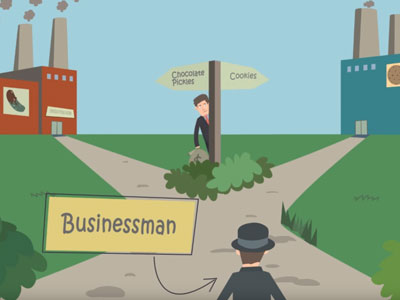
Economic Booms and Busts

Prices

Rule of Law

The Challenge of Living in a Modern Society
Who is F.A. Hayek?
Download the Book
Get a digital copy of the book. Choose the version you prefer below.
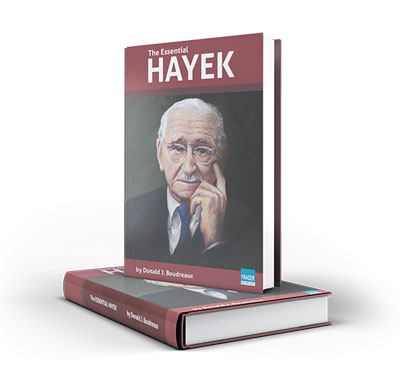
Explore the Book
Chapter by chapter summary of the book.
-

Chapter 1
How we make sense of an incredibly complex world
Recent innovations have allowed people to read materials using a wide variety of mediums, including iPads, computers, and even phones. But the original and still most familiar format is paper and ink. Yet the complexity of the coordination required to allow people to read even in this simple format is hard to believe. It illustrates one of Hayek’s most profound insights: the ability of society to organize itself based on the pursuit of individual interests.
-

Chapter 2
Knowledge and Prices
Imagine yourself standing alone before a gigantic table covered with one billion puzzle pieces. What are the chances that you alone can put these pieces together so that the final result is a coherent visual image—a useful and valuable final result? The answer is “virtually zero.” The size and complexity of the puzzle ensures that putting a central planner (or committee of planners) in charge of assembling the puzzle won’t work.
In the real-world economy, each owner of private property has incentives to use his or her property in ways that produce the greatest return. Efficiency is improved and a complex pattern of productive uses of resources emerges spontaneously. And because this unintended, spontaneous outcome emerges from the self-interested actions of owners of private property, each of these owners is made better off.
-
Chapter 3
Individual Flourishing and Spontaneous Order
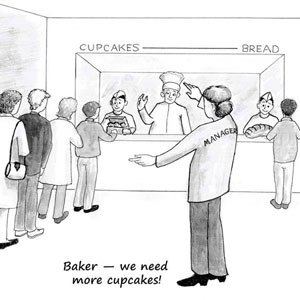
If Betty the baker notices that the price of cupcakes is rising relative to the price of white bread, she will shift some of her effort—along with some of her flour, yeast, and space in her oven—from baking white bread to baking cupcakes. The higher price that she can now fetch for her cupcakes is a signal that she can earn more profits by baking and selling more cupcakes. The rising price of cupcakes reflects an important change in consumer wants.
Prices set in market economies “tell” people just how they can best serve others’ interests. Prices are the single most important sources of information for producers and consumers on what they can expect from others in market economies. A market economy, therefore, expands the ability of each of us to pursue our own goals by harnessing the cooperation of others.
-
Chapter 4
The Rule of Law, Freedom, and Prosperity
How can we be sure that free people will not act selfishly in ways that further their own individual interests at the expense of the general welfare? One part of the answer is that in fact we do expect people to behave in their own self-interest. In a market economy, producers want to become as wealthy as possible, but to do so they must compete against each other for consumers’ patronage. This system rewards success at pleasing consumers, and punishes, with economic losses, the failure to do so.
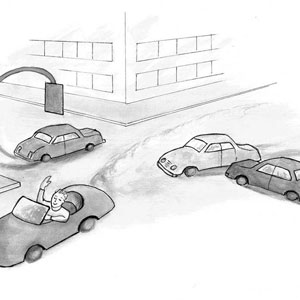
Another part of the answer is the rule of law—a system of rules that are impartial and applied equally to everyone. Rules of the highway, for example, hold all drivers impartially to the rules of the road, so every driver forms a reliable set of expectations about how other drivers will act. What’s true of the rule of law on the roads is true of the rule of law more generally. This equality does not guarantee equality of outcomes. But it does mean that no person’s or group’s interests are given extra weight or are singled out to be discounted.
-

Chapter 5
Legislation is Distinct from Law
The great bulk of law that governs human interactions was not invented and designed by some great Law Giver. Instead, law evolved. Every day we obey a vast set of rules that are not consciously designed. Consider how parking spaces in shopping malls are allocated on busy shopping days. The first person to stop his car near a parking space being abandoned and to put his blinker on in the direction of that space is widely recognized as having established for himself a temporary property right to that space. It is a right that other drivers generally recognize. That is an example of law that is created spontaneously. Law is not always legislated, but it is generally obeyed. Socially beneficial rules of behaviour often emerge and are enforced independently of the state.
-

Chapter 6
False Economic Security and the Road to Serfdom
A government committed to protecting people from any downsides of economic change requires nearly unlimited powers to regulate and tax. As long as people can find some way to change their lives for the better, some fellow citizens are likely to suffer falling incomes as a result. The only way to prevent such declines is near-total government control over the economy. Unfortunately, because economic growth is economic change that requires the temporarily painful shifting of resources and workers from older, unprofitable industries to newer ones, the prevention of all declines in incomes cannot help but also prevent economic growth. So achieving complete protection of all citizens at all times from the risk of falling incomes means not only being ruled by an immensely powerful government with virtually no checks on its discretion, but also the eradication of all prospects of economic growth.
-
Chapter 7
Economic Booms and Busts
Relative prices are the most important “directors” of economic activity. If the pattern of relative prices accurately reflects the many different demands of consumers as well as the costs of the inputs that can be used to satisfy these demands, then entrepreneurs, investors, and consumers will be led by these prices to act in ways that result in all of the economy’s “pieces” being fitted together into a productive whole. The economy at large will work pretty smoothly. If, for example, consumers come to like oranges more than they had in the past, then the price of oranges will rise relative to the price of grapefruits. Farmers will soon produce more oranges and relatively fewer grapefruits. But if prices become out of whack—when prices in most markets send out misinformation—widespread economic troubles arise.
-

Chapter 8
The Curse of Inflation
Even a very moderate degree of inflation is dangerous because it ties the hands of those responsible for policy by creating a situation in which, every time a problem arises, a little more inflation seems the only easy way out. The difficulty of stopping inflation is very much like the difficulty of letting go of a tiger’s tail. The mechanics of doing either task are incredibly easy: just stop printing money (to stop inflation) or relax the muscles in your hand (if you’re holding a tiger by the tail). Yet in light of the anticipated consequences of stopping inflation or of releasing a tiger’s tail, the task in either case is indeed challenging.
-

Chapter 9
The Challenge of Living Successfully in Modern Society
Every day, each of us participates in two very different kinds of social arrangements: interactions with people who we know and care about; and strangers—the millions of people in the great global web of economic cooperation. One of the greatest challenges to those of us who live in modern society is to be able to function comfortably within both types of arrangements. The challenge lies in the fact that behaviours that are appropriate in one of these arrangements are often inappropriate in the other, and vice-versa. We use informal, non-commercial decision-making procedures and norms in small-group settings, and formal interactions based on mutual consent and governed by an ethic of kept promises in our interactions with countless strangers. The success and sustainability of modern society requires that each of us be guided by our small-group norms when interacting with people we know personally, yet put those norms aside when interacting with strangers.
-
Chapter 10
Ideas Have Consequences
There can be no doubt that ideas have consequences. Ideas about the appropriate role of government determine what government will attempt to do as well as what it must refrain from doing. No society, for example, will follow a policy of free trade if a dominant idea in that society is that trade with foreigners is evil or economically harmful. In contrast, no society will tolerate high tariffs and other protectionist measures if a dominant idea in that society is that restrictions on trade are ethically unacceptable and that free international trade is always economically beneficial. Getting ideas “right”—and spreading those right ideas as widely as possible—is therefore of the highest importance. Widely held mistaken ideas about markets and government will inevitably produce economically damaging policies, while correct ideas about markets and government will foster economically beneficial policies.
About the Author

Donald J. Boudreaux
Donald J. Boudreaux is a professor of economics and former economics-department chair at George Mason University and a senior fellow with the Fraser Institute. He is also a senior fellow with the F.A. Hayek Program for Advanced Study in Philosophy, Politics, and Economics at the Mercatus Center at George Mason University and holds the Martha and Nelson Getchell Chair for the Study of Free Market Capitalism at the Mercatus Center. Boudreaux specializes in globalization and trade, law and economics, and antitrust economics.
Boudreaux is committed to making economics more accessible to a wider audience, and he has lectured across the United States, Canada, Latin America, and Europe on a wide variety of topics, including antitrust law and international trade. He is the author of the books Hypocrites and Half-Wits: A Daily Dose of Sanity from Cafe Hayek and Globalization. His articles appear in such publications as the Wall Street Journal and US News & World Report as well as numerous scholarly journals. He writes a blog (with Russell Roberts) called Cafe Hayek and a regular column on economics for the Pittsburgh Tribune-Review. He has appeared numerous times on John Stossel’s Fox show to discuss a range of economic issues.
Previously, he was president of the Foundation for Economic Education and an associate professor of legal studies and economics at Clemson University. He also serves as an adjunct scholar at the Cato Institute.
Additional Resources
Essential Scholars is brought to you by

Fraser Institute
Institute for Economic Affairs
Institute of Public Affairs
Foundation for Economic Education
Acknowledgements
Made possible by generous grants from the Lotte and John Hecht Memorial Foundation, the John Templeton Foundation, and the Peter and Joanne Brown Foundation.